Website redesign costs in 2026 typically range from $1,000 for a simple visual refresh to $100,000 or more for an enterprise-level redesign or full rebuild. The exact price depends on the website’s size, functionality, platform, integrations, content volume, and SEO migration requirements. Small-business redesigns average $2,500 to $8,000, while ecommerce and enterprise projects cost significantly more. If you need to evaluate how much does a website redesign cost for your business, this guide breaks down realistic pricing by website type and project scope so you can plan your budget with confidence.
A website redesign can look like a straightforward visual upgrade until you start defining what actually needs to change. A new design may involve restructuring pages, improving user experience, rebuilding features, updating content, preserving search rankings, or moving the site to a different platform. Each of these decisions can change the total project cost.
That is why website redesign pricing varies so widely from one business to another. A small company updating an outdated brochure-style website has very different requirements from an ecommerce brand rebuilding its online store or an enterprise migrating a large, complex website.
The key is to understand what you are paying for before setting a budget. This guide explains the cost of a website redesign in 2026 by website type and project scope, along with the factors that can increase or decrease the final price. It will help you estimate the investment required for your specific redesign and identify where your budget is likely to go.
Website Redesign Cost by Website Type and Project Scope in 2026
When calculating how much does a website redesign cost across different business models, project scope is the primary differentiator. Most industry guides evaluate only page counts or company size. In practice, a twenty-page corporate site with custom CRM connections requires far more investment than a hundred-page personal blog running on a basic template.
The framework below combines website type and project scope to provide realistic website redesign pricing for planning your budget.
| Project Scope and Website Type | Typical Planning Range | What Is Included | Typical Timeline |
|---|---|---|---|
| Visual Refresh | $1,000–$3,500 | Updated typography, color palette, image replacements, and CSS styling adjustments on your existing CMS | 1–3 weeks |
| Small-Business Website Redesign | $2,500–$8,000 | 5–15 standard pages, custom template design, responsive layouts, contact forms, and baseline on-page SEO | 4–6 weeks |
| Strategic Business-Site Redesign | $8,000–$25,000 | 15–50 pages, custom UX strategy, bespoke templates, CRM integration, content migration, and full SEO preservation | 6–10 weeks |
| Ecommerce Website Redesign | $10,000–$45,000+ | Product catalog setup, custom cart and checkout flows, payment gateways, ERP or inventory sync, and conversion optimization | 8–14 weeks |
| Enterprise Redesign or Rebuild | $25,000–$100,000+ | Custom backend architecture, multi-system enterprise integrations, multi-language support, security compliance, and full QA | 12–24 weeks |
The ranges in this guide are indicative planning estimates compiled to help businesses understand potential website redesign budgets. They are not fixed quotes, guaranteed prices, or a substitute for a project-specific proposal.
Visual Refresh
A visual refresh ranges from $1,000 to $3,500 and focuses purely on surface aesthetics. Your existing CMS, database, URL structures, and back-end logic remain untouched. Work includes updating brand colors, typography, button styles, hero graphics, and CSS spacing. This tier suits companies whose underlying platform is stable and fast, but whose visual presentation looks dated. It is not suitable if your site suffers from broken functionality, poor navigation, or technical SEO deficiencies.
Small-Business Website Redesign
A small-business redesign ranges from $2,500 to $8,000, delivering a complete front-end overhaul for service companies, local firms, and early-stage ventures. This scope covers 5 to 15 standard pages such as Home, About, Services, Case Studies, and Contact. It includes responsive mobile layouts, contact and lead forms, standard CMS setup on WordPress or Webflow, and basic on-page SEO. It is best suited for boutique consultancies that need a clean, credible digital presence to generate qualified inquiries.
Strategic Business-Site Redesign
A strategic business-site redesign costs between $8,000 and $25,000. At this level, custom website pricing shifts from surface styling to commercial growth strategy. Agencies analyze buyer journeys, competitors, and conversion pathways before designing layouts. The project covers 15 to 50 pages with multiple custom templates for distinct service lines, industry verticals, and resource libraries. It includes CRM integration with platforms like HubSpot or Salesforce, blog migration, and a structured SEO preservation plan. Mid-market B2B firms choose this scope when their website serves as their primary customer acquisition engine.
Ecommerce Website Redesign
An ecommerce redesign typically ranges from $10,000 to $45,000 or more. Online stores introduce technical complexity because every design choice directly affects conversion rates and checkout completion. Deliverables include product catalog structuring, faceted search filtering, streamlined cart and checkout flows, and payment gateway connections with Stripe or PayPal. Developers also configure inventory synchronization, shipping rate rules, and ERP connections. Standard Shopify stores sit near the lower end of this tier, while custom WooCommerce, Magento, or headless builds with extensive SKUs require investments toward the higher end.
Enterprise Website Redesign or Rebuild
Enterprise redesigns range from $25,000 to $100,000 or more, requiring strict engineering governance, security compliance, and cross-departmental coordination. Work includes custom backend workflows, decoupled architectures, database migrations with tens of thousands of URLs, and multi-region localization. Developers connect enterprise platforms such as SAP, Salesforce, data warehouses, and single sign-on systems. The engagement concludes with accessibility audits, security penetration testing, and thorough quality assurance across hundreds of device combinations.
Other Website Types and Special Cases
Certain website models align within these broader pricing tiers:
- WordPress Websites: Most business redesigns run on WordPress, typically landing between $3,000 and $18,000 depending on whether the project customizes a framework or builds bespoke Gutenberg blocks.
- Nonprofit Websites: Nonprofits usually invest between $3,000 and $12,000, requiring donation processing, volunteer sign-up forms, annual report archives, and event calendars.
- Standalone Landing Pages: Redesigning a dedicated conversion landing page or microsite costs between $800 and $2,500, covering responsive UI design, persuasive messaging alignment, and tracking pixel integration.
- One-Page Websites: A single-page website with smooth anchor navigation costs between $1,000 and $3,000, offering a fast solution for brand launches and specialized service practices.
- Service-Based Business Sites: These websites focus on scheduling and customer inquiries, spanning $3,500 to $12,000 depending on custom booking engines and client portal requirements.
- AI-Built and Vibe-Coded Websites: Automated site builders and vibe-coding tools produce preliminary layouts for $200 to $1,500. However, these platforms often require professional developer intervention later to correct code bloat, resolve security gaps, and implement proper SEO redirects.
Need a realistic estimate for your website? Share your redesign requirements with our team for a project-specific cost breakdown.
Do You Need a Website Redesign or a Full Rebuild?
A major factor in determining how much does a website redesign cost is whether your underlying codebase can be salvaged. Many business leaders assume any major digital update requires starting from scratch, but that assumption often leads to over-scoping and unnecessary expenses.
The table below contrasts the core requirements and investment levels of each approach.
| Evaluation Factor | Website Redesign | Full Website Rebuild |
|---|---|---|
| Existing Foundation | Kept intact; core templates, styling, and page assets are refreshed | Replaced completely; new technology architecture and database structure |
| CMS and Codebase | Retained; existing themes or code modules are refactored | Replaced or rebuilt from scratch on a modern CMS or framework |
| SEO Migration | Moderate; focused on updated page templates, metadata audits, and modified URLs | Extensive; full URL remapping, content restructuring, and comprehensive 301 redirects |
| Typical Planning Range | $5,000–$25,000 | $20,000–$75,000+ |
| Typical Timeline | 4–8 weeks | 8–16 weeks |
Choosing a Redesign
A website redesign makes sense when your CMS is stable, your hosting setup performs well, and your administrative team enjoys the backend editing experience. If your current site suffers only from dated visuals, poor mobile responsiveness, or declining conversion rates, a redesign solves these issues efficiently. Rebuilding an entire software foundation when the database and CMS are sound wastes capital that could be better spent on conversion optimization, copywriting, or marketing campaigns. A redesign preserves your structural investments while modernizing user experience.
Choosing a Full Rebuild
A full website rebuild becomes necessary when your existing foundation prevents business growth. You should budget for a full rebuild when your current CMS has reached end-of-life status, accumulated technical debt makes adding new features slow and costly, or database queries crash servers during traffic spikes. A rebuild is also essential when executing a corporate repositioning that requires fundamentally different data models. In these situations, attempting to patch an obsolete core costs more in maintenance over two years than rebuilding properly from the ground up.
What Drives Website Redesign Cost?
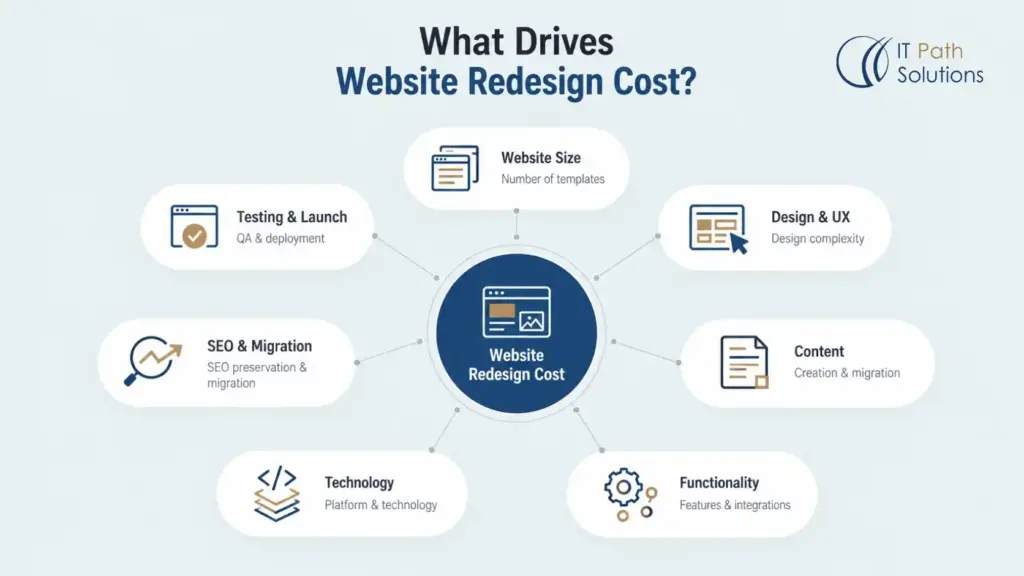
To understand how much does a website redesign cost for your specific situation, you have to look at the technical architecture behind each page. Two websites with similar page counts can require vastly different budgets based on back-end functionality, asset readiness, and integration depth.
The following factors determine where your project lands within our planning ranges.
Website Size and Number of Templates
Page count is a common reference point, but unique template count is what truly drives development hours. A blog with 300 articles uses only one or two underlying templates: a listing layout and an individual post layout. Once developers build and test those two templates, populating hundreds of posts requires minimal effort. In contrast, a 30-page corporate website with ten distinct, custom-designed templates requires significantly more design, frontend development, and QA testing. When gathering quotes, focus on how many unique page layouts your website requires rather than just counting URLs.
Design and UX Complexity
Custom visual design requires extensive research, wireframing, and iterative testing. Using pre-built UI components or off-the-shelf theme frameworks keeps design costs low. However, creating custom iconography, interactive product configurators, custom micro-interactions, and tailored user flows increases project time. If your brand guidelines require meticulous custom styling and original motion design, budget for the upper tier of design services.
Content Creation and Migration
Content often causes unexpected delays and added expenses during redesign projects. If your internal team provides finalized, proofread copy and optimized imagery before development starts, you will save substantial budget. If your agency must conduct stakeholder interviews, write new copy from scratch, shoot original photography, or manually format hundreds of legacy case studies, expect your project cost to increase accordingly.
Functionality and Integrations
Static pages that display text and images are straightforward to build. Costs rise when your website must connect with your broader operational software stack. Common integrations that impact website redesign cost include CRM platforms such as Salesforce or HubSpot, custom customer portals, gated resource libraries, and enterprise resource planning systems. Advanced lead routing forms and automated payment calculation APIs also require dedicated development hours.
Platform and Technology
Your choice of content management system influences upfront development costs and recurring maintenance fees. Open-source platforms like WordPress offer deep flexibility and vast plugin ecosystems, but they require ongoing security monitoring. Hosted platforms like Webflow or Shopify streamline hosting and security, but they introduce subscription fees and customization boundaries. Custom web applications built on modern frameworks like Next.js, React, or Laravel require specialized engineers, which increases initial development costs.
SEO and Migration Requirements
An established website carries significant equity in search engine rankings, backlinks, and organic visitor traffic. Failing to protect this equity during a redesign can cause immediate traffic drops that take months to recover. A thorough SEO migration involves cataloging all existing URLs, creating comprehensive 301 redirect maps, transferring meta titles and descriptions, preserving schema markup, and auditing internal link structures. The more organic traffic and ranked pages your site holds, the more critical this work becomes.
Testing, QA and Launch
Professional web agencies do not launch a redesigned website without thorough quality assurance. Comprehensive testing covers cross-browser compatibility across Chrome, Safari, Firefox, and Edge, as well as responsiveness across mobile resolutions. Engineers verify form validation, payment processing, and email notifications while optimizing Core Web Vitals and load speeds. Pre-launch staging reviews and disciplined DNS cutover execution prevent broken customer journeys on launch day.
How AI Can Affect Website Redesign Costs
Modern engineering teams use AI-assisted tools to streamline repetitive tasks during development. Developers use automated coding assistants to generate boilerplate scripts, format data structures, and draft initial test cases. Designers use AI to assist with rapid layout exploration and image preparation.
These efficiencies reduce project hours on routine development tasks. However, AI cannot replace experienced software architecture, custom business logic, secure API integrations, strategic UX research, or complex SEO migrations.
For an in-depth breakdown of automated workflows and modern development expenses, explore our guide on AI website development cost.
Additional Costs to Budget For
When planning your web budget, remember that your vendor quote covers core design and development. Certain operational features and specialized services represent additional scope that must be layered on top of base redesign figures.
SEO Migration and Technical SEO
Potential additional SEO and migration cost: $1,500–$10,000.
If your business relies on Google search for revenue, budgeting for dedicated SEO migration is mandatory. This scope covers legacy site indexing audits, meticulous 1-to-1 redirect mapping, canonical tag verification, schema markup updates, and post-launch Google Search Console monitoring. Skipping this line item is the most common reason businesses lose traffic after launching a new design.
Ecommerce Functionality
Potential ecommerce-related additional scope: $3,000–$25,000+.
Adding transactional capabilities to a marketing site requires specialized engineering. This additional budget accounts for secure merchant gateway connections, inventory sync mechanisms, customer account portals, cart recovery emails, and automated tax calculation engines.
Content and Other Add-Ons
Depending on internal resources, you may need to budget for specialized professional add-ons:
- Professional Copywriting: Professional copy production costs between $100 and $300 per page for conversion-focused messaging and industry research.
- Multilingual Translation and Localization: Setting up multi-language directory structures and translation management typically ranges from $2,000 to $8,000.
- Accessibility Compliance: Conducting WCAG 2.1 AA audits, keyboard navigation testing, and screen reader optimization costs between $1,500 and $5,000.
- Advanced Analytics Setup: Implementing Google Tag Manager event tracking, custom conversion goals, and executive dashboard reporting ranges from $1,000 to $3,500.
- Custom CRM and ERP Integrations: Developing bi-directional data synchronization and custom webhook connections costs between $3,000 and $15,000.
- Client Portals and Custom Dashboards: Engineering secure user authentication, role-based permissions, and proprietary data views ranges from $5,000 to $20,000.
How Much Does a Website Redesign Cost by Provider?
The type of partner you hire has an enormous impact on your final invoice. Every provider model comes with distinct advantages and practical trade-offs.
| Provider Type | Typical Planning Range | Advantages | Considerations and Best Fit |
|---|---|---|---|
| Full-Service Agencies | $10,000–$100,000+ | Complete multidisciplinary team with UX strategists, developers, SEO experts, and QA engineers | Higher cost than freelancers and longer discovery or approval processes. Best for mid-market and enterprise businesses. |
| Freelancers | $2,000–$10,000 | Direct communication, flexible arrangements, and lower hourly billing rates | Variable availability and limited cross-discipline skills. Best for small businesses with straightforward requirements. |
| In-House Teams | Salary-based ($60,000–$120,000+ per hire) | Intimate company knowledge, dedicated focus, and immediate internal access | High ongoing overhead and potential skill gaps in specialized platform migrations. Best for enterprises with continuous build needs. |
| DIY and AI Site Builders | $200–$2,000 | Lowest direct cash expense, simple templates, and immediate deployment | Requires extensive internal labor, provides limited custom features, and lacks SEO migration. Best for early prototypes and micro-businesses. |
Freelancers and in-house developers represent sensible choices for specific business stages. If you run a local business or an independent consulting practice with five static pages, hiring a reputable freelancer provides great value without agency overhead. Similarly, if your company manages multiple web properties and requires daily feature releases, an in-house team is financially justified.
When evaluating DIY tools, distinguish self-serve template software from professional AI-assisted development. DIY platforms give you rigid templates that require your own time to configure. Professional agencies use AI inside custom engineering environments to build secure, scalable, and fully custom digital products.
When Is It Time to Redesign Your Website?
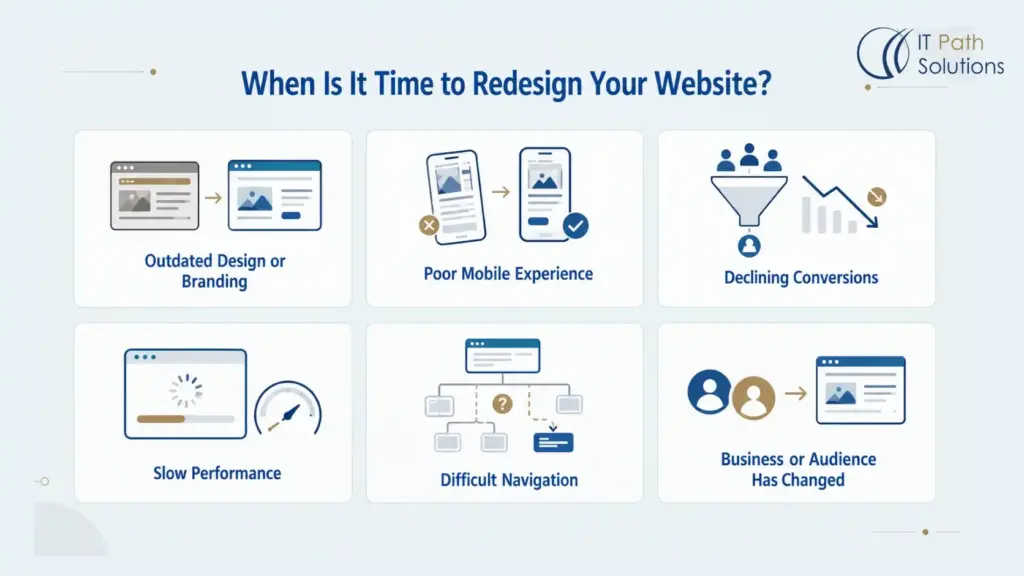
If you are already reviewing pricing guides, you likely know your website needs attention. Here is a quick validation checklist of symptoms that signal an update is necessary.
Outdated Design or Branding
Web design standards evolve rapidly. If your website features cluttered layouts, dated typography, or low-resolution imagery, visitors will question your company’s credibility within seconds of landing on your page.
Poor Mobile Experience
Over half of all web traffic originates from mobile devices. If smartphone visitors encounter unreadable text, awkward pinch-to-zoom requirements, or broken touch targets, your website is actively driving potential customers away.
Declining Conversions
If traffic remains steady but contact form submissions, demo requests, or phone calls are dropping, your user experience has failed. A modern redesign removes friction and establishes clear conversion paths.
Slow Performance
Visitors abandon web pages that take more than three seconds to load. Slow load speeds also harm your search engine visibility, as Google prioritizes fast, Core Web Vitals-compliant websites in search rankings.
Difficult Navigation
As companies grow, they frequently add new service offerings and pages haphazardly. Over time, navigation menus become confusing labyrinths that prevent users from finding critical product details and pricing information quickly.
Business or Audience Has Changed
If your company has shifted from small business clients to enterprise accounts, introduced new service tiers, or refined its brand positioning, your website must reflect that strategic evolution. An old website speaking to an outdated target audience will attract the wrong leads.
How to Budget for a Website Redesign
When estimating how much does a website redesign cost, you should establish a structured budgeting methodology to avoid scope creep and protect cash flow.
Follow these practical steps to build an accurate internal budget.
Start With Clear Objectives
Tie your redesign investment directly to commercial outcomes. Are you seeking to double qualified inbound leads, decrease mobile bounce rates by 30%, or automate client onboarding? Defining clear success metrics helps you justify project spend to internal stakeholders.
Separate Must-Haves From Nice-to-Haves
List all intended features and categorize them strictly into mandatory requirements and secondary enhancements. If your budget is limited, launch the core website first and release secondary features during later project iterations.
Account for SEO, Content and Migration
Never treat copywriting and SEO migration as minor postscripts. Assign dedicated budget and internal personnel to content preparation early in the project timeline to prevent launch delays.
Plan for Post-Launch Costs
A successful website launch is the beginning of your digital lifecycle, not the end. Reserve annual budget for secure cloud hosting, plugin and CMS licenses, ongoing technical maintenance, conversion rate testing, and regular content updates.
Keep a Contingency
Unforeseen challenges arise during technical projects, especially when dealing with legacy databases and third-party APIs. Always maintain a contingency reserve of 15% to 20% beyond your initial vendor quote to accommodate unexpected requirements smoothly.
| Project Phase | Recommended Budget Allocation | Primary Activities |
|---|---|---|
| Discovery and Strategy | 10%–15% | Audience research, competitor benchmarking, and information architecture |
| UI and UX Design | 25%–30% | Wireframing, design systems, and responsive desktop and mobile prototypes |
| Development and Integrations | 30%–35% | Frontend development, backend coding, CMS setup, and API connections |
| Content and SEO Migration | 10%–15% | Content production, image optimization, URL mapping, and redirect setups |
| Testing, QA and Launch | 10% | Device testing, performance optimization, and DNS deployment |
| Contingency Reserve | 15%–20% | Buffer for scope adjustments, legacy code fixes, and feature additions |
How to Evaluate a Website Redesign Quote
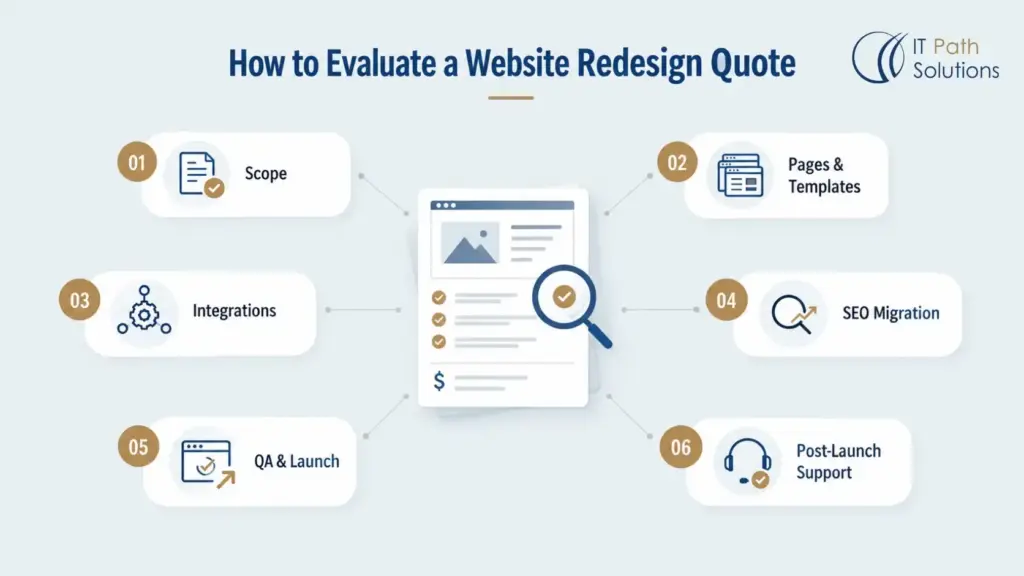
Receiving proposals from different web agencies can feel overwhelming when pricing models vary drastically. Use this framework to evaluate quotes objectively on an apples-to-apples basis.
Check What the Scope Includes
Verify whether the proposal outlines distinct phases for discovery, design, development, content migration, testing, and deployment. Vague proposals with a single lump-sum number often lead to surprise billing when standard deliverables are deemed out of scope.
Confirm Page and Template Count
Ensure the proposal clearly specifies both total page count and unique custom template count. Confirm who is responsible for populating content across remaining interior pages so your team is not surprised by unexpected data entry work.
Check Integrations
Ensure all required software integrations are explicitly named in the contract. A quote that lists general CRM integration may only cover a basic contact form embed, whereas you may require bi-directional lead sync and custom field mapping.
Verify SEO Migration Work
Confirm that technical SEO migration is detailed as a dedicated deliverable. Your vendor should explicitly commit to compiling a 301 redirect map, updating metadata, preserving canonical tags, and checking Google Search Console post-launch.
Ask About QA and Launch
Review the vendor’s quality assurance methodology. The contract should guarantee cross-browser testing, mobile device verification, performance benchmarking, and a structured launch checklist.
Understand Post-Launch Support
Inquire about what happens after launch day. Does the agency provide a 30-day warranty window to fix unforeseen bugs at no extra charge? Do they provide CMS training sessions and recorded video documentation for your internal marketing staff?
Website Redesign Cost Estimators
Online cost calculators provided by platforms like WebFX, Upwork, and Clutch offer helpful starting points for high-level research. These automated tools allow you to toggle features like page counts, design tiers, and ecommerce functionality to generate quick ballpark estimates.
However, automated estimators cannot evaluate the condition of your existing database, uncover hidden technical debt, or gauge complex third-party API requirements. Use them to establish broad budget boundaries, but rely on detailed agency discovery sessions for actionable, binding project quotes.
Conclusion
Understanding how much does a website redesign cost allows you to plan your upcoming investments with clarity and discipline. In 2026, realistic website redesign pricing falls into five core tiers:
- Visual Refresh: A surface-level styling update costs between $1,000 and $3,500.
- Small-Business Website Redesign: A foundational redesign for local or boutique companies ranges from $2,500 to $8,000.
- Strategic Business-Site Redesign: A growth-focused B2B redesign with custom layouts and CRM integration costs between $8,000 and $25,000.
- Ecommerce Website Redesign: An online storefront with product catalogs, custom checkout flows, and ERP sync ranges from $10,000 to $45,000 or more.
- Enterprise Redesign or Rebuild: A complex, multi-system corporate redesign or platform rebuild costs from $25,000 to $100,000 or more.
Your specific project price depends on which existing assets can be retained, how many custom templates your site requires, and the depth of development, migration, integration, and SEO preservation needed.
Need a realistic estimate for your website? Share your redesign requirements with our team for a project-specific cost breakdown.
Frequently Asked Questions
How much does a website redesign cost in 2026?
In 2026, website redesign costs typically range from about $1,000 for a simple visual refresh to $100,000 or more for an enterprise-level rebuild. IT Path Solutions generally sees small-business redesigns fall between $2,500 and $8,000, strategic business-site redesigns between $8,000 and $25,000, and ecommerce redesigns from $10,000 to $45,000 or more, with the final number depending on size, functionality, platform, integrations, and SEO migration needs.
What is the difference between a website redesign and a rebuild?
A redesign updates an existing website’s look, content, or parts of its functionality while retaining most of the underlying foundation and CMS. A rebuild replaces the technology itself, often the CMS, codebase, or platform, because the current setup can no longer support the business’s needs. IT Path Solutions typically prices redesigns at $5,000 to $25,000 and rebuilds at $20,000 to $75,000 or more, since rebuilds involve more architecture, migration, and testing work.
How long does a website redesign take?
Most website redesigns take 4 to 8 weeks from kickoff to launch, while full rebuilds typically run 8 to 16 weeks due to added architecture, integration, and testing work. The final schedule depends on the number of pages and templates, content readiness, technical requirements, client feedback, and the agreed review process. IT Path Solutions provides a project-specific timeline after assessing the website and scope.
Can I redesign my website without losing SEO rankings?
Yes, but only with deliberate SEO migration planning. Rankings are typically lost when redirects are missing or incorrect, URL structures change without mapping, metadata is not carried over, or site speed regresses after launch. IT Path Solutions treats SEO migration as a distinct budget line, typically $1,500 to $10,000 on top of the base redesign, precisely because skipping this step is the most common cause of post-launch traffic drops.
Can I redesign my website in phases?
Yes. Phased redesigns let a business spread cost and risk over time. For example, updating the homepage and core templates first, then tackling ecommerce or integration-heavy sections later. IT Path Solutions often recommends phasing for mid-size and enterprise projects where a full simultaneous relaunch would strain internal teams or budget cycles, as long as the site’s information architecture and SEO structure are planned holistically from the start.
What should I prepare before requesting a redesign quote?
Before requesting a quote, gather your current site’s page and template count, a list of required integrations including CRM, ERP, payment, and analytics, any known SEO or content migration needs, and a rough budget range. Sharing this with IT Path Solutions upfront, rather than just a URL, lets the team return a project-specific estimate instead of a generic range.